
Not every PEEK implant is built the same — and the difference determines how your body responds to it.
When patients research facial implants, PEEK (polyether ether ketone) comes up constantly — and for good reason.
It’s strong, lightweight, and doesn’t interfere with future CT or MRI imaging.
But treating “PEEK” like a single, interchangeable material misses something important.
Standard PEEK and bioactive PEEK share the same base polymer.
They are not the same implant.
The difference is in what happens after the implant goes in.
What the Research Actually Shows About Standard PEEK
Standard PEEK is biocompatible, meaning your body tolerates it without an active immune reaction.
But biocompatible only means your body won’t attack it — not that your body integrates with it.
Studies on PEEK implants in craniofacial reconstruction have reported infection rates as high as 8%, with overall complication rates — including infection and implant failure — reaching close to 18% in some case series.
The reason traces back to how standard PEEK behaves once it’s inside the body.
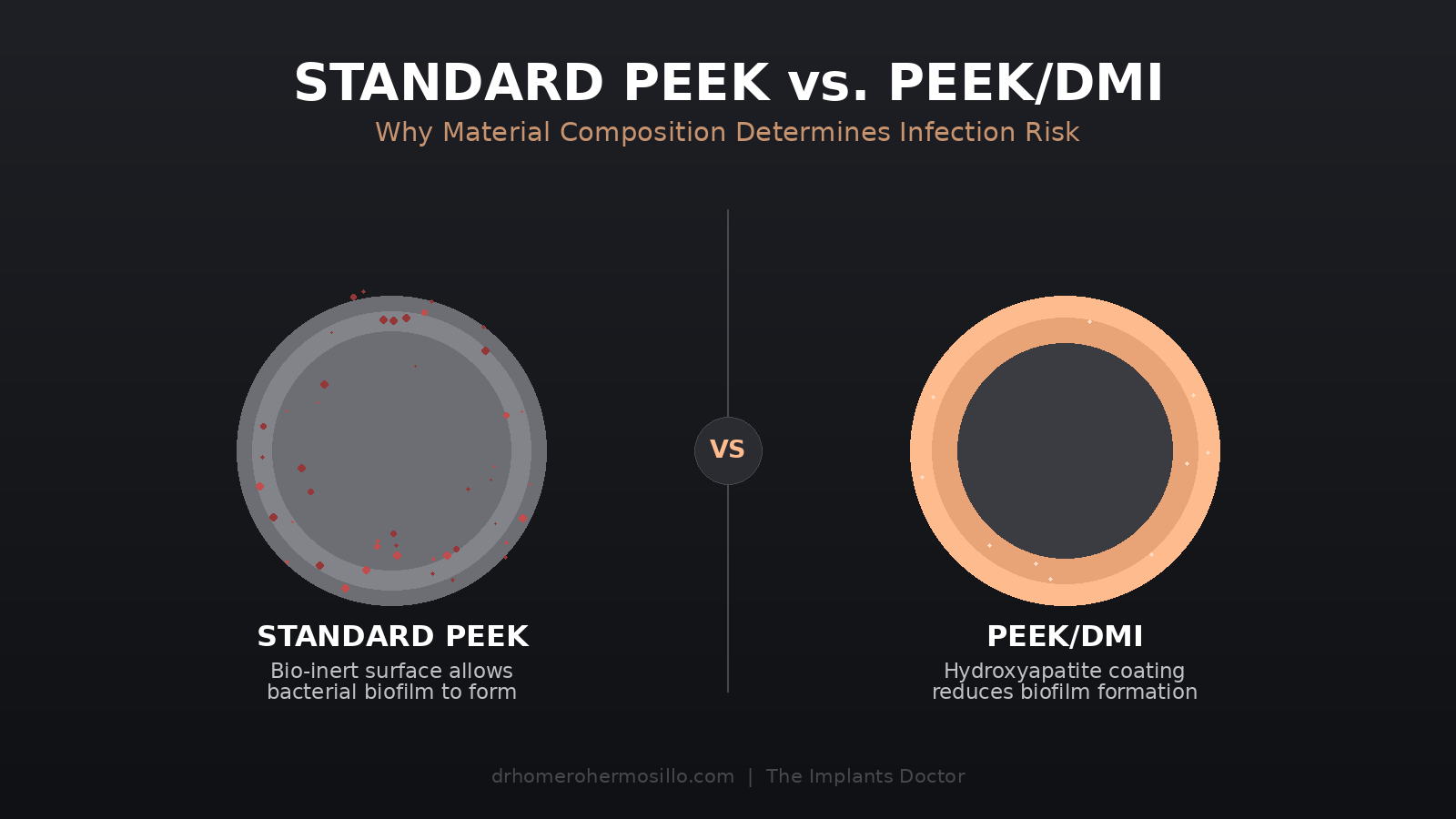
It’s bio-inert and hydrophobic, so rather than fusing with bone and soft tissue, it gets walled off in a fibrous capsule — a thin layer of scar tissue that creates a permanent, unintegrated gap around the implant.
That gap is exactly where problems start. It’s a mechanically weak interface prone to micromovement, and — more relevant to infection risk — it’s a surface bacteria can colonize without the immune system’s normal access to clear it.
Why Hydroxyapatite Changes the Equation
This is where bioactive PEEK — engineered with DMI’s Direct Molecular Integration surface technology — is a genuinely different material, not a marketing label on the same product.
The PEEK matrix is modified with hydroxyapatite (HA), a mineral chemically similar to natural bone. That same surface modification process also makes the implant hydrophilic rather than hydrophobic — the opposite of standard PEEK’s water-repelling surface — and bioactive PEEK implants incorporate additional surface treatments specifically engineered to promote cell attachment alongside the hydroxyapatite.
Independent research on hydroxyapatite-modified surfaces has found meaningful reductions in bacterial biofilm formation. In one study, mature biofilms of two common infection-causing bacteria — S. epidermidis and P. aeruginosa — were reduced by 43–46% on hydroxyapatite surfaces compared to standard implant materials.
Other research on hydroxyapatite-coated PEEK shows improved early bone formation and cell attachment compared to unmodified PEEK.
In practical terms: the combination of hydroxyapatite, a hydrophilic surface, and these additional cell-attachment treatments gives the implant surface biological activity that plain PEEK doesn’t have. Instead of the body isolating the implant behind scar tissue, bone cells and soft tissue can adhere directly to it.
That reduces the unintegrated space where biofilm forms in the first place — and it’s why I don’t offer standard PEEK implants in my practice. Every custom implant I design uses bioactive PEEK’s bone- and tissue-fusing technology.
Why This Distinction Should Matter to You, Not Just to Me
I understand this can sound like an argument two implant companies would have with each other — and to some degree it is.
But the distinction has real consequences for a patient choosing a facial implant.
An infected or poorly integrated implant doesn’t just mean a setback. It often means a second surgery, a longer recovery, and, in some cases, losing the result altogether.
When you’re comparing options, the question isn’t just “is it PEEK?” It’s “what does the surface of this implant actually do once it’s inside you?”
That’s the standard I hold every implant I place to. Not whether it’s biocompatible enough to be tolerated — but whether it’s engineered to genuinely integrate.
Frequently Asked Questions
Is all PEEK the same?
No. Standard PEEK and bioactive PEEK share the same base polymer, but bioactive PEEK’s surface is modified with hydroxyapatite and additional treatments that make it hydrophilic and promote cell attachment — giving it different biological behavior that reduces biofilm formation and supports real integration with bone and tissue.
Does implant material really affect infection risk?
Independent research on hydroxyapatite-modified surfaces has shown meaningful reductions in bacterial biofilm colonization compared to unmodified surfaces, which is one of the reasons I use bioactive PEEK exclusively for every implant I design.
Why doesn’t every surgeon use bioactive PEEK?
Standard PEEK is well-established, less costly to source, and biocompatible enough to pass regulatory testing — which is why it remains widely used, even though it doesn’t integrate with the body the way an engineered, hydroxyapatite-modified surface can.
A Material Built to Integrate, Not Just Be Tolerated
Every implant I design starts with your CT scan and uses bioactive PEEK’s bone- and tissue-fusing technology.
Because a facial implant should become part of you — not just sit inside you.
If you’re considering facial implants and want to understand exactly what material is being used and why, I invite you to schedule a complimentary virtual consultation.
Let’s talk about what’s actually inside the implant, not just what it’s called. See the full technical breakdown on our Implant Material page, or explore how it’s used in facial feminization and facial masculinization surgery. For the complete overview, see our guide to bioactive PEEK facial implants in Mexico.